

Understand the Barriers.
Create the Solutions.
Public benefit programs are successful in reducing poverty and improving economic well-being, but many Illinois households who are eligible for benefits don’t receive them.
Read an overview of public benefits enrollment challenges on this page. Or dive deeper into the causes and consequences of under-enrollment by exploring the resource section below.

Overview
Poverty exists in every county and community in Illinois, impacting 11 percent of Illinoisans, including one in seven children. [1]
In addition to being widespread, poverty’s impacts are pervasive. Poverty is more than a lack of money. It deprives individuals of opportunity and basic needs, negatively impacting their physical and mental health, causing food and housing insecurity, and reducing opportunities for education and employment. [2]
Whether a child trying to learn, an adult earning a living, or an older adult managing chronic illness, poverty makes it harder for individuals to reach their full potential.
Public benefit programs provide critical support to low-income households, lifting them out of poverty by helping meet basic needs like food, housing, health care, and utilities. [3] In fact, when accounting for the impact of government assistance, the number of people in poverty is reduced by about two-thirds. [4]
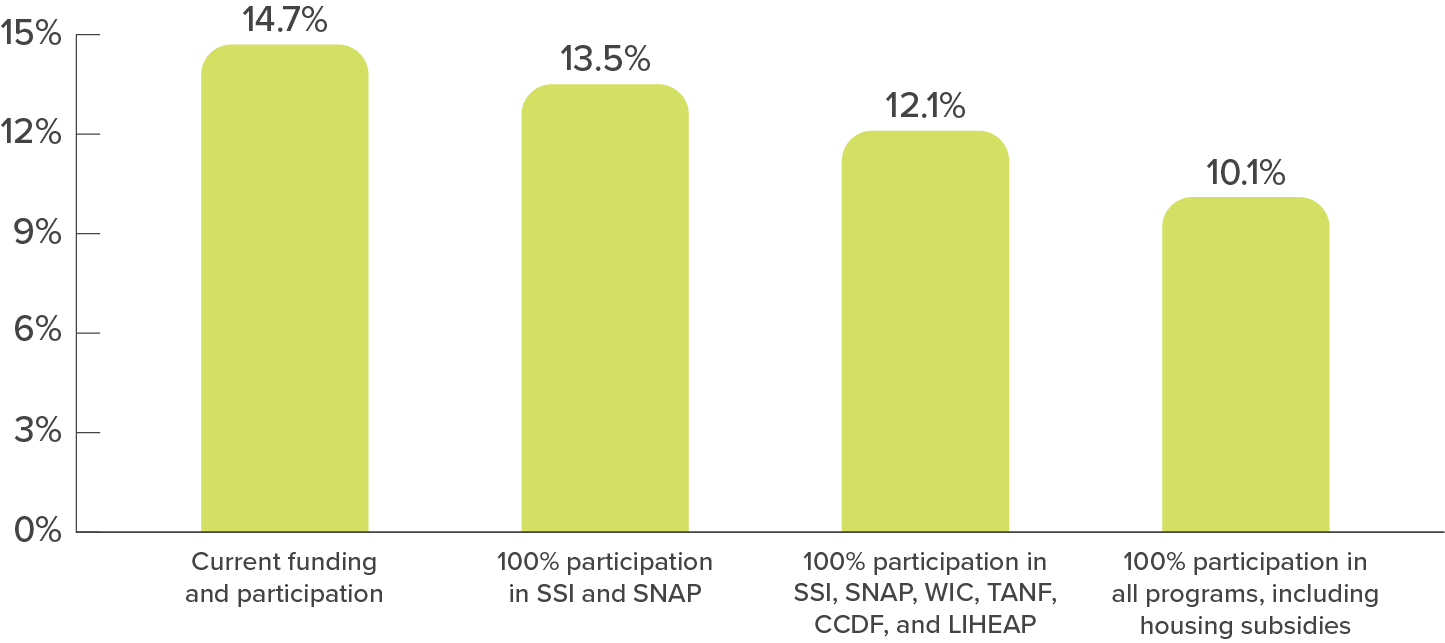
Increasing participation in public benefit programs would further reduce poverty. The Urban Institute estimates that maximizing participation in core safety net programs would reduce the overall poverty rate by 31 percent and child poverty by 44 percent, a transformative change for Illinois families and communities. [5]
Poverty Rates Would Decrease with Increased Public Benefit Program Participation [6]
-
Urban Institute, Analysis of Transfers, Taxes, and Income Security (ATTIS) model applied to 2018 American Community Survey data projected to 2022.
Unfortunately, only a fraction of people who qualify for public benefit programs are enrolled.
Some federal programs do not provide enough funding to serve all who are eligible. To help close the gap, Illinois contributes state resources to complement federal funds to be able to serve more Illinois households, for example with the Child Care and Development Fund (CCDF) and Low Income Home Energy Assistance Program (LIHEAP). [7]
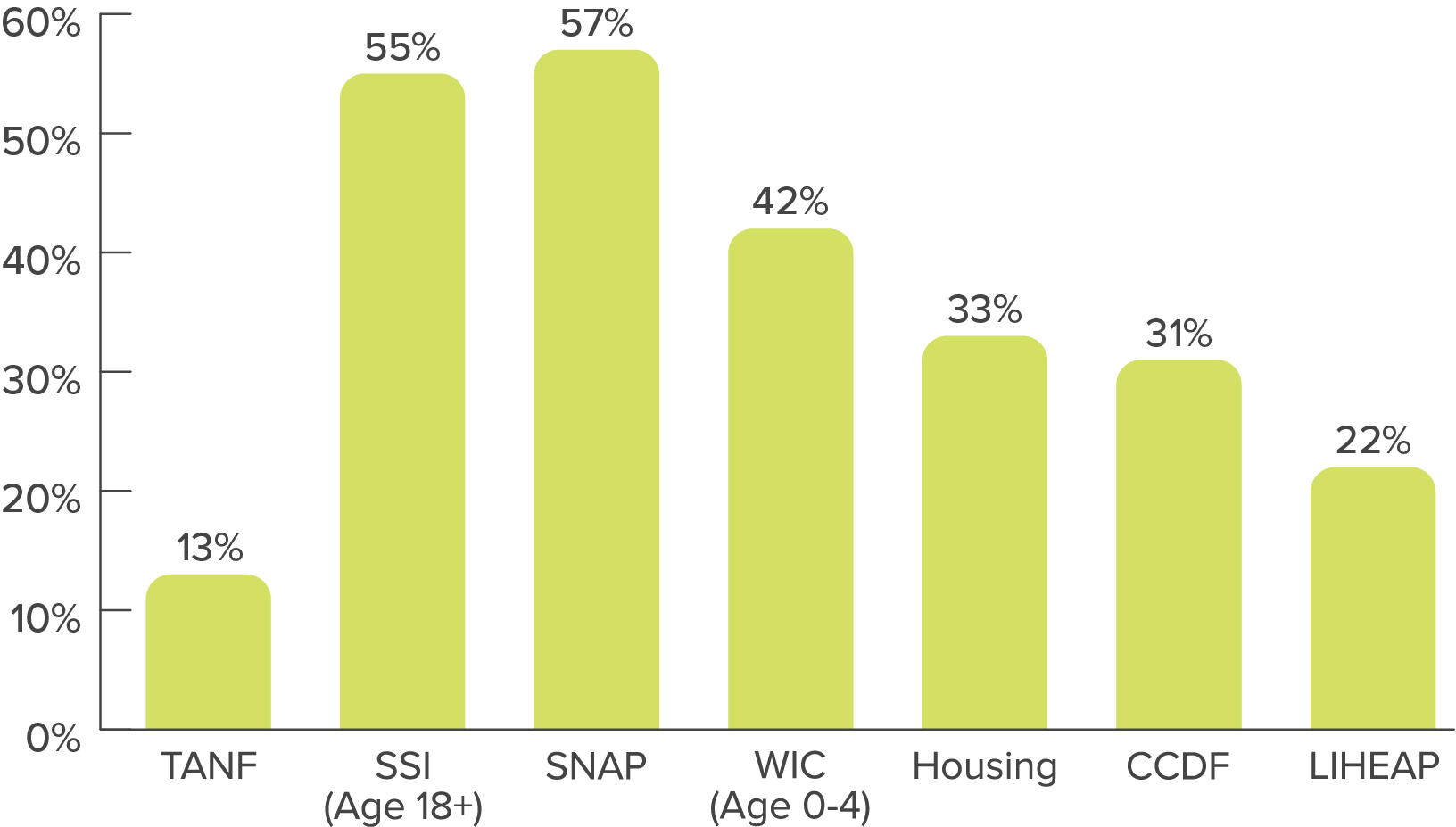
Other programs provide sufficient federal funding to serve all who are eligible, but Illinois does not enroll all who qualify. Illinois could increase enrollment in Medicaid, the Special Supplemental Nutrition Program for Women, Infants and Children (WIC), the Supplemental Nutrition Assistance Program (SNAP), and Supplemental Security Income (SSI) and draw down additional federal resources to support low-income families.
Percent of Eligible Illinois Individuals or Families Participating in Safety Net Programs, 2018 [8]
-
Eligibility estimates are from the Urban Institute, using the ATTIS model (Analysis of Transfers, Taxes, and Income Security) applied to the 2018 American Community Survey. Numbers of participants obtained from publicly available program administrative data.
The consequences of public benefit under-enrollment are significant and impact all of us.
Under-enrollment in public benefit programs keeps hundreds of thousands of Illinoisans in poverty. Households lacking essential resources turn to community organizations for support, increasing strain on local communities.
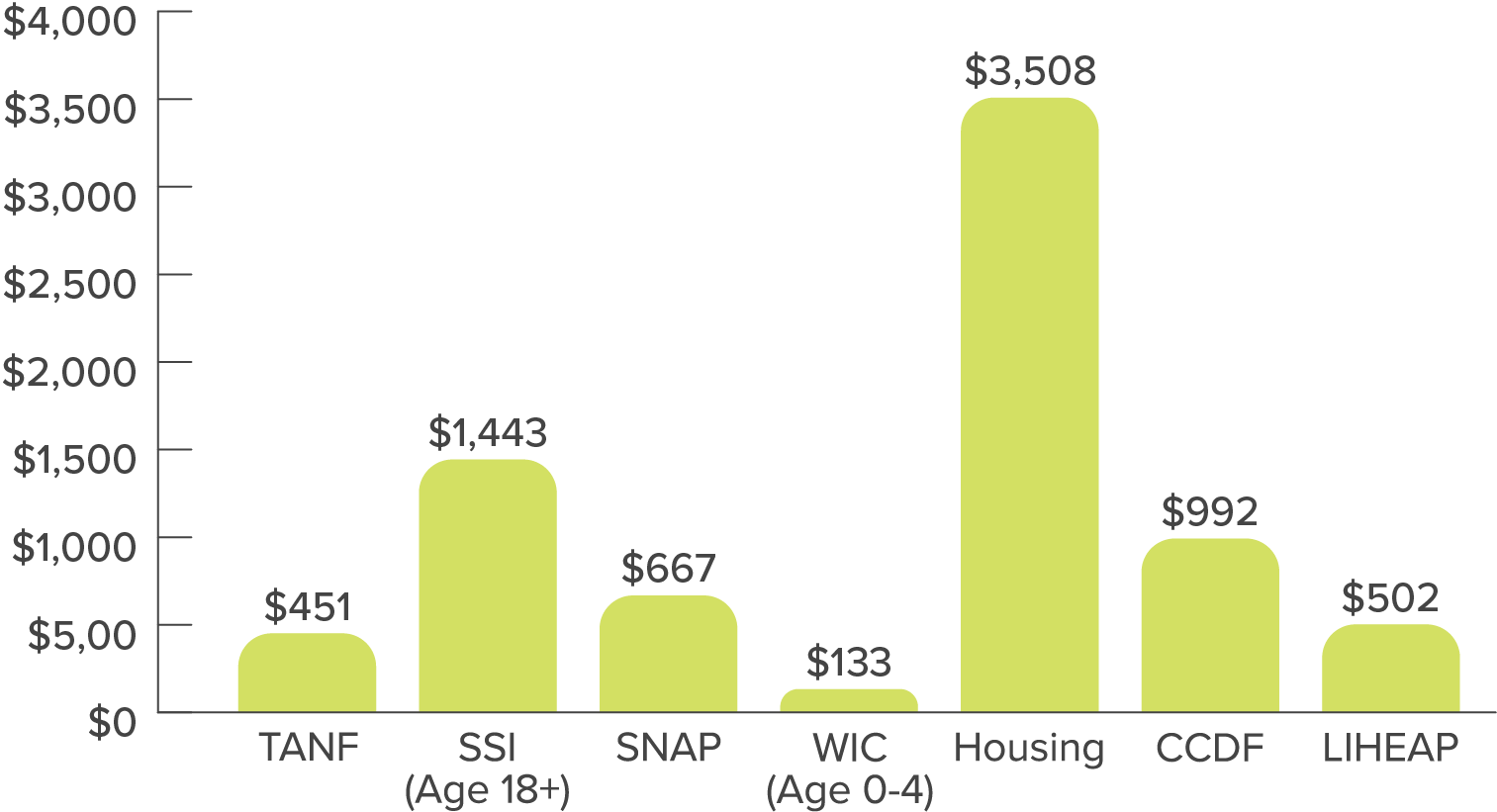
By enrolling more eligible individuals in public benefit programs, Illinois could draw down billions in additional federal dollars each year to better support families and communities. [9]
Value of Untapped Safety Net Benefits in Illinois, 2018 (millions of dollars) [9]
-
Urban Institute, using the ATTIS model (Analysis of Transfers, Taxes, and Income Security) applied to the 2018 American Community Survey.
There are a number of reasons why people don’t enroll in the public benefit programs they are eligible for, including:
Silos created by programs operating under different federal, state, and local agencies make it difficult and time consuming to understand all the programs available and complete the application process
Inconsistent eligibility requirements across programs and complex program rules create confusion about who qualifies
Incompatible technology platforms create repetition and time burden for program applicants and program administrators
Lack of coordination across programs create missed opportunities to connect families to multiple resources
While some of these require changes at the federal level, there is a lot that Illinois can do to make it easier for eligible individuals to enroll in the safety net programs they qualify for. Read about our plan for transforming Illinois’s safety net.
Explore the resources below to learn more about public benefit program enrollment, including the causes and potential solutions for under-enrollment.
-
U.S. Census Bureau, Quick Facts.
Brookings, Deep Poverty and Its Consequences, May 2015.
As of January 2026, the federal poverty line is $33,000 for a family of four, or $15,960 for an individual. U.S. Department of Health and Human Services, Office of the Assistant Secretary for Planning and Evaluation, 2026 Poverty Guidelines: 48 Contiguous States, January 2026.
U.S. Census Bureau, Government Assistance Lifts 45.4 Million Out of Poverty in 2021, September 2022.
Urban Institute, A Safety Net with 100 Percent Participation: How Much Would Benefits Increase and Poverty Decline? August 2023.
Urban Institute, A Safety Net with 100 Percent Participation: How Much Would Benefits Increase and Poverty Decline? August 2023.
The Child Care and Development Fund (CCDF), housing supports, Low Income Home Energy Assistance Program (LIHEAP), and Temporary Assistance for Needy Families (TANF) are federal programs that do not provide enough funding to serve all who are eligible. Even if Illinois exhausted available federal funding, the state would not have federal resources to serve all who qualify.
Urban Institute, What Portion of Illinois Residents Eligible for Safety Net Benefits Receive Those Benefits? January 2023.
Urban Institute, The Value of Unclaimed Safety Net Benefits in Illinois, January 2023.

Resources
-
Public Benefit Program Participation Rates and Outreach Opportunities, Benefit Illinois, May 2025
What Portion of Illinois Residents Eligible for Safety Net Benefits Receive Those Benefits?, Urban Institute, January 2023
-
A Review of the Potential Impact of Interventions to Increase Public Benefits Utilization, Benefit Illinois, April 2025
A Safety Net with 100 Percent Participation – How Much Would Benefits Increase and Poverty Decline?, Urban Institute, August 2023
The Value of Unclaimed Safety Net Benefits in Illinois, Urban Institute, January 2023
-
Synthesis of Insights: Research with Illinois Households About Safety Net Programs, April 2025
Learnings From Focus Groups with Illinois Households, Benefit Illinois, May 2025
Learnings From a Survey with Illinois Community Based Organizations, Benefit Illinois, May 2025
Illinois Benefit Hub & MyFriendBen Illinois Pilot Learnings, Benefit Illinois, January 2026
Illinois Benefit Hub User Testing Learnings, Benefit Illinois, February 2026
-
A Review of Federal Policy Waiver Opportunities to Streamline Public Benefits Enrollment, Benefit Illinois, April 2025
What Illinois Can Learn from Other State Approaches to Digital Transformation and Modernization, Benefit Illinois, May 2025